In the poetry collection, Plumstead Pram Pushers, Beswick ruminates on adolescence, relationships, and the disparagement of women through terms like ‘slag’.
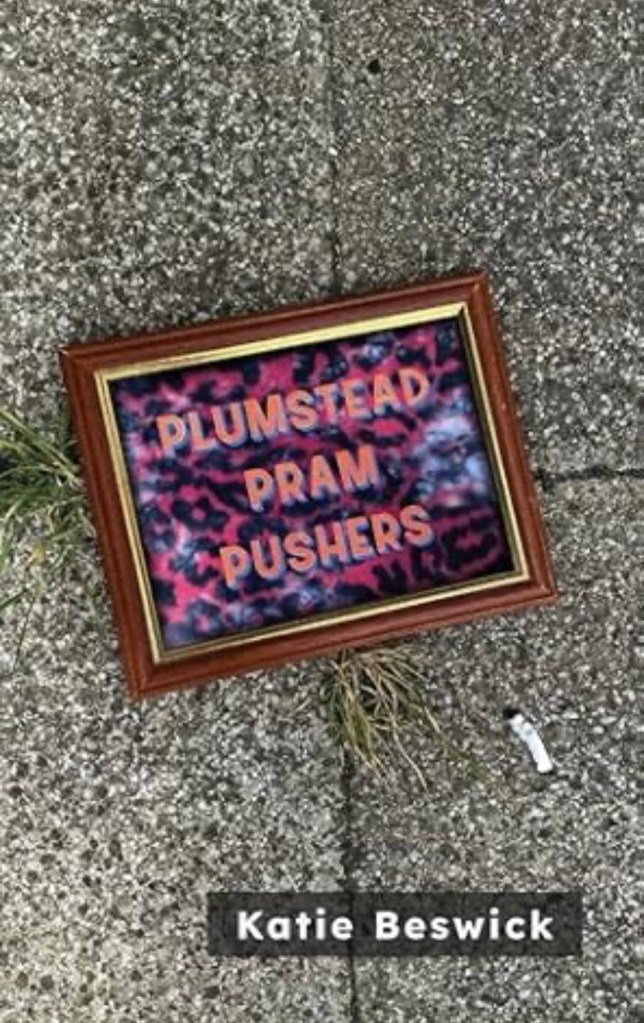
Beswick’s poetry collection starts with a quote: “Adolescence is intense and enduring…Trying to deal with our own desires, or lack of them, alongside budding desirability to others, feels dizzying. We are touched and touch in new ways — sometimes these touches are wanted, sometimes they are not (sometimes, it’s not even clear to us what we want).”
Her chapbook, Plumstead Pram Pushers, captures that dizzying feeling of adolescence perfectly. With poems about desire, relationships, and sex, Beswick highlights the vulnerability of those teenage years — the yearning to discover yourself and your place in the world.
With poems ranging from ‘The Blues’ that delve into mental health (“Not even sadness, this feeling I have/it’s enduring, like the long note held at the end of the last song.”) to ‘Classy Birds’ that captures a memory of teenage girls chatting with men online (“Our screen name was ClassyBirds/and we roosted in chatrooms.”) to ‘Pretty in Pink’ about Beswick’s pregnancy with her daughter (“In a locked cubicle, I watched, and two lines turned pink./Time stretched its elastic and whole worlds burned pink”), Plumstead Pram Pushers embodies the heart-warming and messy process of self-exploration, particularly when society has already deemed a person a certain way.
Each poem is striking, raw, and powerful. The collection does not hold punches, but leans into the deepest bruises we all share.
I had the opportunity to interview Beswick and learn more about the inspiration behind Plumstead Pram Pushers and her writing process as a poet:
What was the inspiration behind this collection?
In my writing I often work with similar themes to those that emerge in this collection — class, sex and desire, longing. I’ve done this across a range of forms, in academic writing, a novel draft, and I used to write an award-winning blog about sex and relationships too. So there isn’t a single inspiration as such, rather a convergence of themes and images that seemed to come together into a coherent whole. For this collection, my main aim was to use the form of poetry to express something about the relationship between an emerging adolescent self and who you become. This is a question that occurs in a lot of my work — how do our background and formative experiences, especially during adolescence, shape our emotions and what we choose to do with our lives? For me that is the central question of the collection, but answered through an emotional exploration, specifically grounded in the location of my upbringing (Plumstead, south east London). I hoped to use my experiences and the experiences of those close to me to say something more universal.
What is your writing process like?
It depends on the project, and where I am in my life in terms of other pressures and stresses. I try to write every day — or at least do some productive reading/research towards whatever project I’m working on. This year, so far, I’ve written a poem every day — this isn’t to say they are all fantastic — some are very silly little rhymes, but I do think it is important to keep up a regular practice of writing if you are serious about the craft. It can be difficult to fit it in around family life, but setting aside time, or using downtime on public transport, in the bathroom, or wherever is important. I also increasingly take writing classes and workshops (I’m a big fan of The Poetry School). I’m very interested right now in form and technique, and how these can be used as tools to sharpen your work, and add complexity. Feedback from others is vital too; it is very difficult to know how a poem will be received until you get that feedback from readers, so finding ways to develop drafts through feedback is also really important to me. Perhaps because I have a background in theatre, I am always thinking about the audience, the eventual reader, and what my work is creating for them. Because you might write for yourself, but you publish for others, and I consider it a duty of the writer to think about the relationship between the text and the end reader. That’s not to say we should not challenge others, or be true to ourselves, but you have to know what you are doing to the reader — it ideally shouldn’t come as a surprise to the writer when their words have a particular effect.
You mention having a fascination with the word ‘slag’, and this comes up in poems like ‘Slaggy Manor’ and ‘Slag/noun:’. What do you think it is about this word that compels you to write about it?
Slag is a term in British-English that usually refers to a woman with a reputation for being sexually reckless (a little like slut, although I’d argue more insulting). It also has associations with prostitution, and parallel meanings associated with industrial processes (where ‘slag’ is the leftover product from e.g. smelting) — so it is bound up with class politics and sex inequity. Alongside this poetry collection, I am also working on a scholarly book that traces the origins of the word ‘slag’ and thinks about its uses in art and popular culture. The cultural critic Raymond Williams wrote about what he called ‘key words’, which are significant words that occur in the culture, particularly in social and political debate. I started thinking about the word ‘slag’ as a key word that had shaped my experiences of growing up in a working class neighbourhood in the late twentieth and early twenty-first century. I think the word and its wider ramifications influenced the lives of two or three generations of women, and in my poetry I explore that social and emotional terrain that the word ‘slag’ occupies.
What’s your favorite poem in the collection? Can you tell me a bit about it?
I was initially hesitant to choose, but actually I do have an answer to this: ‘New Year’s Couplet’ is my favourite. The poem is really a pair of poems that explore early childhood memories of Chinese New Year in east London and the birth of my daughter as parallel events that echo one another. They work with the concept of New Year as a threshold, and with what for me were formative and estranging experiences of difference and uncertainty. What I like about the poems is that I feel they really capture the essence of the experiences I wanted to relate. They are strong and important moments that I feel come across vividly in the writing. I like the sense of repetition I managed to employ across the two poems and the concept of the dragon and the tiger as these two very different but very powerful forces.
Why do you write poetry?
Writing is something I have always done to one degree or another — I think it is as simple as I enjoyed reading from an early age, and wanted (as I think is natural in many readers) to try and do for others what writers had done for me, in creating worlds and images and ideas that expanded the horizons of my mind and life. Poetry is, I think, the most demanding form of writing as it calls for precision, musicality, openness to experience and the ability to translate a very personal terrain to something more public. Of course, it is easier in one sense to write a poem than it is to write a novel, but to create a body of great poetry that speaks beyond the self and endures is extremely difficult. It is exciting to me to push the limits of what words can do, and to participate in the lineage of an art form that is so fundamental to many cultures. Poetry, rhyme and song are how stories survive, although we are obsessed in our consumerist culture with ‘the book’ (me as much as anyone else) — actually what will survive us are the stories and poems that can be recalled, orated and passed through generations. That is exciting to me.
What are you working on next?
I’m currently working on a few things. I am finishing up my scholarly book on ‘slags’, which I hope to have sent to the publisher by the end of the summer. So it should be out next year. I’ve also recently finished the draft of a second chapbook, which covers similar themes to Plumstead Pram Pushers, but focuses more on the urban environment — and am working on a full length poetry collection, which is a little different. Neither of those has publishers attached, so part of the work I have to do is also thinking about where they might be placed for publication. I also have a draft of a novel that I should really do something with…
Many thanks to Katie Beswick for her time and to Matthew Bullen at Red Ogre Review for the advanced copy of Plumstead Pram Pushers! If you’d like to purchase your own copy, you can find it here.


Leave a Reply